Why You Can’t Stop Doomscrolling at Night (And What Helps Before Bed)
Doomscrolling before bed often fills a late-night gap, not a lack of discipline. Choose a small, ready replacement before evening begins each day at home.
How this was written: drafted with an AI model from sources the author chose and checked; last reviewed Oct 2, 2026.
Part of the digital wellbeing guide: what to do with the time you get back from your phone.
Doomscrolling before bed is often less about weak discipline than a late-night gap: the things you might otherwise do are unavailable, while your phone is lit, close and ready. Decide on a tiny replacement before evening, then make the phone’s usual landing place inconvenient.
In short
- A late-night scroll is easier to interrupt when you choose its replacement while you still have energy to choose.
- The best bedtime alternative is usually nearby, simple and already prepared.
- A boundary that you can revise is often more useful than a rule you resent.
Why is doomscrolling before bed so hard to stop?
At bedtime, your phone can become the last easy option still standing. Work is finished, friends may be unavailable, the house is quieter and any hobby that needs equipment, decisions or effort feels oddly far away. The feed, meanwhile, asks only for a thumb.
That doesn't make the scrolling meaningless or foolish. It may be a way to postpone the end of the day, catch up on what happened, avoid an unfinished thought, or find a small pocket of time that feels entirely yours. The problem is that a feed doesn't naturally tell you when that pocket has ended.
This is why someone who barely checks social media in the afternoon can lose an evening to it. In the afternoon, there are competing cues: a task, a colleague, food to make, a place to go. At night, the cue to pick up the phone can meet very little competition. Our earlier guide on why doomscrolling is hard to stop looks at the loop itself; before bed, it helps to look at the empty space around it too.
Calling this a discipline failure usually adds shame without adding an alternative. A more useful question is: when I reach for my phone at bedtime, what could my hand reach for instead?
Is the screen light the whole problem?
No: light can matter, but the content and the extra time can matter as well. In a controlled laboratory study, participants reading on a light-emitting eReader before bed had different results for circadian timing, sleep and next-morning alertness than when they read a printed book; it's useful evidence about evening light, but it doesn't explain every real-life late-night scroll. Read the original paper. (doi.org)
A phone can also keep the day mentally open. A tense headline, a group-chat reply, a shopping decision or a video that leads to another video may be more relevant to your night than the brightness setting. Even a very dim screen can keep you occupied long after you meant to put it down.
That is why “turn on a warmer display” can be a reasonable adjustment but not a complete plan. If the issue is that bedtime keeps being delayed, the more direct boundary may be deciding where the phone goes and what begins in its place. For more on that wider picture, see why not to use your phone before bed.
This is part of practical digital wellbeing: making technology fit the part of life it is entering, rather than expecting a single setting to solve every kind of use.
What should I do instead of scrolling before bed?
Choose one replacement that is easy enough to do when you are tired, not the ideal evening routine you imagine on a good day. “Read more” is too vague if the book is downstairs, the bookmark is missing and you haven't picked one. “Put the novel on the pillow” is a usable instruction.
Your replacement doesn't have to be especially worthy. It can be a printed novel, a comic, a crossword, moisturizer by the sink, a few stretches you already know, laying out tomorrow’s clothes, or simply sitting with a warm drink. The aim isn't to make the evening perfect; it's to give the reach for the phone somewhere else to land.
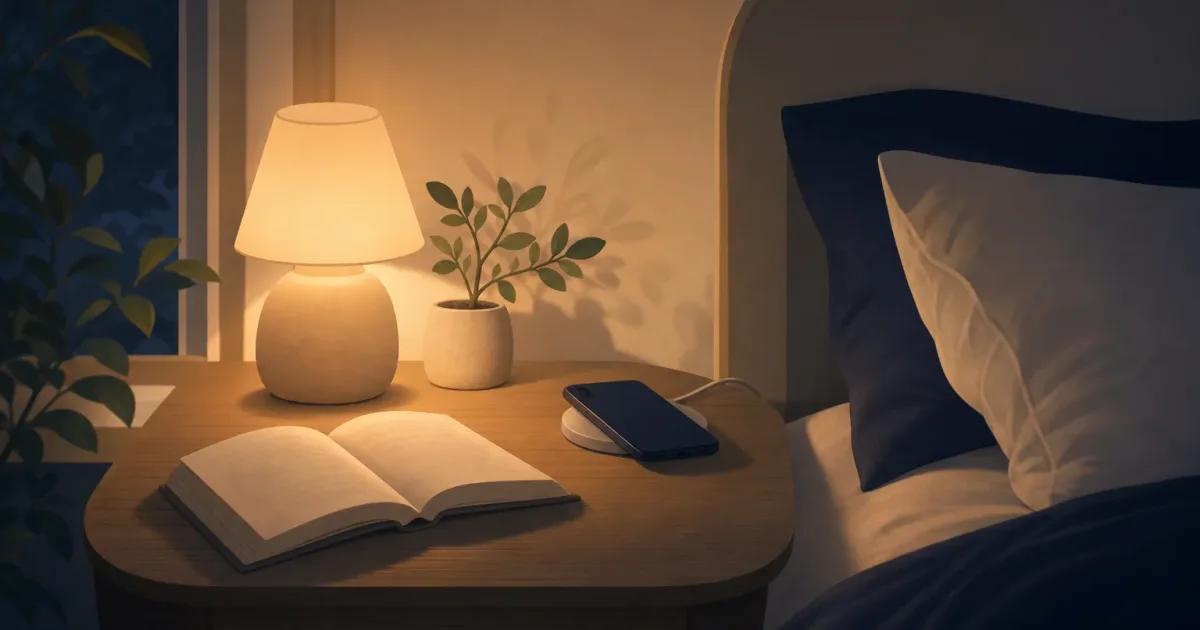
Here is one concrete thing to do today, with no app required. Before your evening starts, put a charger outside the bedroom or across the room. Put one low-effort object where the phone normally rests: a book, notebook, puzzle or even a glass ready for water. When you enter the bedroom, leave the phone at the charger, pick up the object, and tell yourself: “I can check my phone after I have done this.” You're not banning the check; you're giving the first reach a different destination.
If that feels too strict, shrink it further. Leave the phone on the bedside table but place the replacement on top of it. The physical order matters because it turns an automatic motion into a small choice. Our ideas for what to do instead of scrolling are designed for exactly these short gaps, rather than for a perfect phone-free evening.
Should I use iPhone Screen Time or an app blocker at night?
Use the lightest boundary that matches what you need. If you want a firm scheduled limit, iPhone’s built-in Screen Time can set schedules, app limits and downtime; Apple also lets you choose which apps remain available during downtime. See Apple’s Screen Time instructions. (support.apple.com)
That may be the best answer if you genuinely want certain apps unavailable at night. It's free, built in, and avoids adding another tool to manage. It may feel too blunt, though, if you need an app for a message, an address, a child, work or a moment when you simply choose to continue.
A pause-style blocker is a different fit. Rather than trying to make the decision impossible, it puts a moment between opening an app and entering the feed. That can suit someone whose real goal is to notice the choice before the habit gets going. Our honest shortlist of iPhone app blockers explains the difference between limits, blockers and pause tools.
No app can supply the missing alternative by itself. If your phone is the only comforting, available thing beside the bed, a block may become another obstacle to override. Put something else within reach first, then decide whether a limit or pause would make that choice easier to repeat.
How do I make the pause stick when I am tired?
Make the pause shorter than the argument you would otherwise have with yourself. At night, an elaborate routine can become one more thing to avoid. A brief breath, a look at a personal reminder, or a single sentence in a notebook may be enough to reveal whether you actually want to open the app.
It also helps to separate noticing from judging. If you end up scrolling, you have learned something about the moment: perhaps the replacement was not close enough, perhaps the phone was needed, or perhaps the boundary started too late. Adjust the setup the next day instead of treating one imperfect evening as proof that it can't work.
If you like an opening-time interruption rather than a timed lock, a mindful reset can offer a short breath, affirmation, meditation or visual reminder before you enter a chosen app. The important part isn't performing the reset perfectly; it's getting a chance to choose while there is still a choice to make.
You don't need to remove every screen from your evening. You only need a plan for the moment your day has gone quiet and the phone has become the default. Make that plan in daylight, place it where your hand will find it, and leave room for real life.
Champ is an iPhone app that shields chosen apps with a bypassable reset before you enter them; download it.
Frequently asked questions
Why do I doomscroll before bed but not during the day?
What is the best thing to do instead of scrolling before bed?
Should I block social media completely at night?
Can I still use my phone before bed without doomscrolling?
Sources
- Anne-Marie Chang, Daniel Aeschbach, Jeanne F. Duffy, and Charles A. Czeisler. (2015). Evening use of light-emitting eReaders negatively affects sleep, circadian timing, and next-morning alertness. Proceedings of the National Academy of Sciences
- Apple. Set schedules with Screen Time on iPhone. Apple Support
- Champ. The 30-second reset. Champ
Screen time guides and tools
One idea about screen time, every two weeks.
The Pause: a short note from the person who builds Champ. Occasional, not daily. Unsubscribe any time.